How Strict Can an App Blocker Be? The Vow, and Six Locks Ranked

When people compare app blockers, the first question is usually "which is best." The second, almost every time, is "which is the most strict." It is the right question, and it deserves a more honest answer than a feature list. Strictness is not one number. It is the answer to a single question: when you regret your own rules at 11pm, who holds the key?
What strict mode actually means
Every blocker faces the same loophole: the person who set the rules can unset them. So the category has grown strict modes, and they differ mainly in where they put the key. Some guard a single focus session and end when it ends. Some make you wait out a timer. Some move the key onto a physical object, so that leaving it at home settles the matter. All of these are sincere attempts at the same thing: protecting the decision you made when you were clear-headed from the person you become when the urge arrives.
We build Catholic DeVice, and our answer to that question is called the Vow. This page explains exactly how it works, including its limits, so you can judge it against anything else on the shelf.
The Vow: a seal, not a cage
The Vow is an opt-in seal you set while sober-minded. In the app it is labeled exactly that: The Vow (Strict Mode). While it is sealed, one rule governs everything it covers: your disciplines may be deepened but never loosened. You can always add a vice app, extend a schedule, or tighten a limit. You cannot remove, shorten, or relax anything until the Vow releases the way you chose when you sealed it.
It covers the whole discipline, not one session: the Vice List and its limits, the Cloister's schedules and any running Retreat, and Custody of the Eyes. And the crucial part is that you choose, in advance, how it releases. There are six release methods, and they are not equally strict. Here they are, ranked from hardest to gentlest.
The six locks, ranked from most to least strict
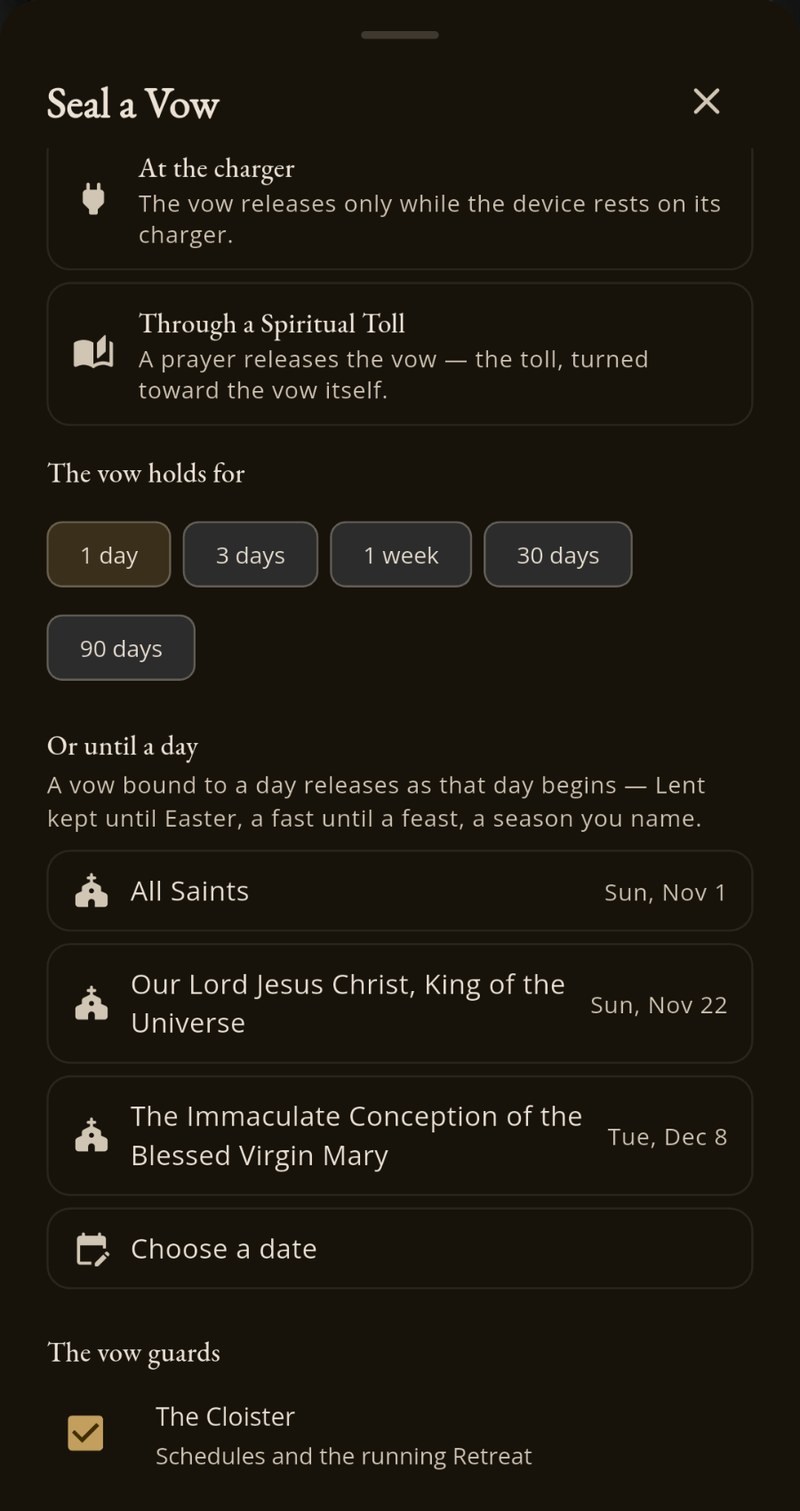
1. The timer. The Vow holds until a day you appoint, then dissolves on its own. Pick a term (a day, three days, a week, 30 days, or 90 days, the length of an Exodus 90 window) or name the day itself: the seal sheet suggests the next feast days from the app's own liturgical calendar, and any date works. Seal it on Ash Wednesday until Easter Sunday and Lent keeps itself. This is the strictest lock we ship, because no early exit exists at all. Not for you, not for anyone. If you seal it until Easter, it holds until Easter.
2. The entrusted PIN. The Vow releases only with a PIN that is meant to be set by someone else: a spouse, a confessor, an accountability partner. A door exists, but it is not in your hands. Its strictness is the strictness of the person you trusted, which is exactly the point.
3. The waiting period. Requesting release starts a cooldown, and the Vow can only be unsealed after it has fully passed. You can always begin the process, but nothing happens tonight. This defeats the impulse, which is where almost every relapse lives, while leaving a settled decision possible.
4. The schedules. The Vow holds whenever any of your Cloister schedule windows is active, and loosening is permitted only in the quiet hours between them. Your protected times protect themselves; changes can only happen in the calm outside them.
5. The charger. The Vow releases only while your phone rests on its charger. It sounds gentle until you notice what it does: it anchors loosening to a place and a posture. Nobody quietly dismantles their disciplines standing at the kitchen counter where the phone charges. The couch scroll never gets the key.
6. The toll. The Vow releases only by completing a Spiritual Toll, a full Catholic prayer, the same wall that guards your vice apps. This is the gentlest lock, and it is the most like the rest of the app: even the least strict door still leads through prayer.
Which lock should you choose?
Not the strictest one. The one that matches how you actually fail. If your failures are impulsive, the waiting period is usually enough, because impulses do not survive delay. If your failures are negotiated, the slow talking-yourself-out-of-it kind, the entrusted PIN or the timer removes the negotiating table. If you mostly need your evenings and Sundays defended, the schedules lock guards exactly that. The Vow is a promise made in a clear moment to the person you will be in a weak one, and promises work best when they fit.
How to set up the Vow
The Vow lives at the bottom of the Cloister. In the app, open The Rule and choose the Cloister tab, then scroll past your Retreats and schedules to the bottom, where the Vow rests. Tap Seal a Vow.
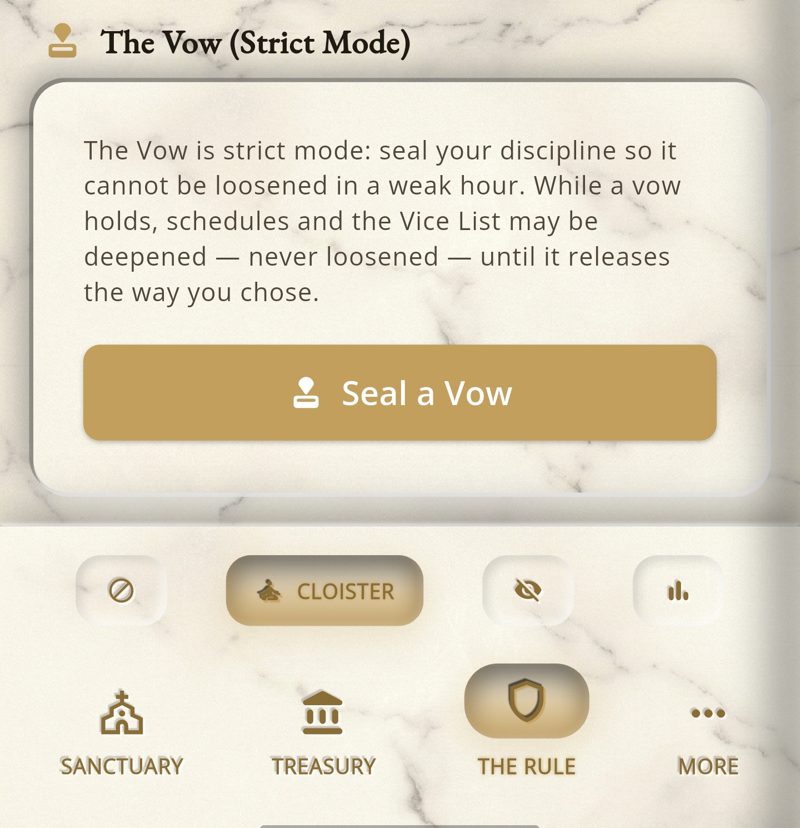
The seal sheet asks you two things. First, what the Vow guards: the Cloister, the Vice List, Custody of the Eyes, or any combination. Second, how it releases. The six locks above appear under their in-app names: Until an appointed hour, By an entrusted key, After a waiting period, During scheduled hours, At the charger, and Through a Spiritual Toll. Set the terms, seal it, and from that moment everything it covers can be deepened but not loosened until the release you chose.
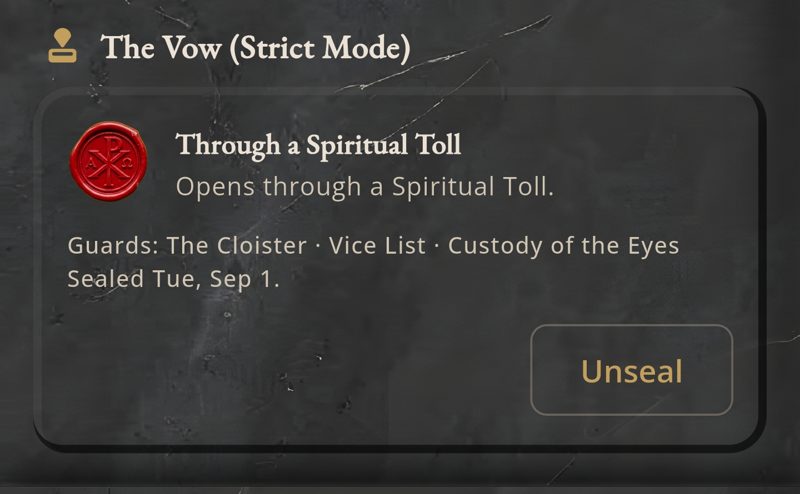
Once sealed, the Vow rests under wax at the bottom of the Cloister: the release you chose, what it guards, and the day it was sealed. That card is all you can see of it until it releases.
The honest limits
No app on any phone can stop you from deleting it. Anyone who claims otherwise is overclaiming, and you should read every strict-mode promise in this category with that in mind. What a well-built seal does is make loosening slow, deliberate, and slightly inconvenient, because the evidence on friction is clear: a pause of even a few seconds collapses most impulsive opens. The Vow is built for that fight, the real one, and not for a theatrical one against your own free will. The Church has never believed grace works by force.
Price and platforms
Catholic DeVice's core loop is free on iPhone and Android: the Praywall on two vice apps, Retreats with no toll and no escape, the daily prayer spine, and all statistics. The Vow, like recurring schedules, is part of premium, and the annual plan starts with a 14 day free trial at the time of writing, so you can seal a real Vow and feel it hold before paying anything. The app is free to try on iPhone and Android.
Related reading: the honest comparison of apps that block apps until you pray · Catholic DeVice vs Opal · why replacement beats restriction
Questions people ask
What is the strictest app blocker?
Strictness depends on where the key lives, not on the app's marketing. Some tools move the key onto a physical object you can leave at home; most keep it behind a timer or a difficulty setting on the phone. In Catholic DeVice the strictest option is a Vow sealed until a fixed date: no early exit exists, and until that date your blocking can be deepened but never loosened. The date can be a day you name outright: the seal sheet suggests the next feast days from the app's liturgical calendar, so a Vow sealed on Ash Wednesday until Easter holds through all of Lent.
What is strict mode in an app blocker?
A strict mode is any setting that stops you from undoing your own blocking in the moment of temptation. Weak strict modes only guard a single focus session. The Vow in Catholic DeVice seals your whole discipline: the Vice List, the Cloister's schedules and Retreats, and Custody of the Eyes, until the release method you chose in advance lets it open.
Is there a free app blocker with strict mode?
Catholic DeVice's core loop is free on iPhone and Android: the Praywall on two vice apps, Retreats that lock apps with no toll and no escape, and all statistics. The Vow itself, the seal that prevents any loosening, is part of premium, like recurring schedules, and the annual plan starts with a 14 day free trial at the time of writing, so you can seal a real Vow before paying anything.
Can you bypass the Vow?
Inside the app, no: while the Vow is sealed, every loosening path is closed until your chosen release method opens it. We are honest about the outer limit: no app on any phone can stop you from deleting it entirely. The Vow's job is to make loosening slow and deliberate instead of instant, because the research on the pause shows impulses die in delay. A settled decision to walk away was never the enemy.
How do you set up the Vow in Catholic DeVice?
Open The Rule, choose the Cloister tab, and scroll to the bottom, where the Vow rests beneath your schedules. Tap Seal a Vow, choose what it guards (the Cloister, the Vice List, Custody of the Eyes), choose one of the six release methods and its terms, and seal it. From then on your disciplines can be deepened but not loosened until the Vow releases.
Can you seal the Vow for Lent or Exodus 90?
Yes. The timer release accepts any end date, and the seal sheet suggests the next feast days from the app's built-in liturgical calendar, so a Vow sealed at the start of Lent until Easter Sunday holds through all of Lent and releases as Easter begins. A 90 day term covers an Exodus 90 window, and any date up to three years out works.
Ready to turn vices into virtues?
Catholic DeVice is free on iPhone and Android. Mark your vice apps, and the Praywall turns the moment of temptation into a moment of prayer.
Get the App Free