A Catholic Advent App for a Season of Penance: How to Prepare for Christmas in 2026
If you searched for a Catholic Advent app, you will find plenty that give you something to listen to: a daily reflection, a guided meditation, a calendar of little doors. Those are good. This article is about the other half of Advent, the half the Church kept for fifteen hundred years and most of us have never been told about: Advent is a season of penance. We build an app for that half, Catholic DeVice, so read this knowing who wrote it. Everything quoted below comes from Scripture, the Catechism, the Roman Missal's own instructions, the 1913 Catholic Encyclopedia, and Dom Prosper Guéranger's The Liturgical Year, and we say where.
Advent 2026 begins on Sunday, November 29, and ends on Christmas Eve.
Advent is a season of penance
The first voice of Advent is John the Baptist, and the Douay-Rheims gives his first words bluntly: "And in those days cometh John the Baptist preaching in the desert of Judea. And saying: Do penance: for the kingdom of heaven is at hand." (Matthew 3:1-2). Bishop Challoner's note on the verse explains the Latin, paenitentiam agite: "Which word, according to the use of the scriptures and the holy fathers, does not only signify repentance and amendment of life, but also punishing past sins by fasting, and such like penitential exercises." Then comes the line the Church reads every Advent: "A voice of one crying in the desert, Prepare ye the way of the Lord, make straight his paths." (Matthew 3:3).
That is how the Church has always read the weeks before Christmas. Dom Guéranger, the Benedictine abbot whose fifteen-volume Liturgical Year shaped how Catholics understand the calendar, opens his history of the season this way: "The mystery of that great day had every right to the honour of being prepared for by prayer and works of penance." The 1913 Catholic Encyclopedia says the same of the season's purpose: "During this time the faithful are admonished to prepare themselves worthily to celebrate the anniversary of the Lord's coming into the world as the incarnate God of love, thus to make their souls fitting abodes for the Redeemer coming in Holy Communion and through grace, and thereby to make themselves ready for His final coming as judge, at death and at the end of the world."
So the preparation is for three arrivals, and Guéranger names them. The coming of Christ is "at once simple and threefold. It is simple, for it is the one same Son of God that is coming; it is threefold, because he comes at three different times and in three different ways." He came in the flesh at Bethlehem, he comes now into the soul by grace, and he will come at the end as judge. Christmas morning celebrates the first. Penance prepares for the second and the third.
St. Martin's Lent: the forty days before Christmas
For centuries this was not a figure of speech. Guéranger records that St. Perpetuus, bishop of Tours about the year 480, "had decreed a fast three times a week, from the feast of St. Martin until Christmas", and he asks the reader to note "this interval of forty, or rather of forty-three days, so expressly mentioned, and consecrated to penance", as though it were a second Lent. The Catholic Encyclopedia gives the next witness: "A synod held (581) at Mâcon, in Gaul, by its ninth canon orders that from the eleventh of November to the Nativity the Sacrifice be offered according to the Lenten rite on Monday, Wednesday, and Friday of the week." The feast of St. Martin is November 11, and the fast that began on it was called St. Martin's Lent.
The readings matched the fast. The Encyclopedia notes that on three Sundays of Advent the old Breviary took its lessons from "the eighth homily of Pope St. Leo (440–461) on fasting and almsdeeds as a preparation for the advent of the Lord". Fasting, almsgiving, and prayer were the Advent program, the same three works as Lent.
Over the centuries the forty days were shortened to four weeks, the fast was softened to abstinence, and by the late Middle Ages it had largely lapsed in the West. The Eastern Churches never let it go; they keep a forty-day Nativity Fast to this day. And Guéranger is careful about what did not change in Rome: "the general character of the Liturgy of this holy time has not changed."
What the liturgy still keeps
Walk into Mass on the First Sunday of Advent and the penance is still there to see. Guéranger: "The people are forcibly reminded of the sadness which fills the heart of the Church by the sombre colour of the Vestments. Excepting on the Feasts of the Saints, purple is the only colour she uses." The Gloria goes silent, "for this glorious Song was only sung at Bethlehem over the crib of the Divine Babe." Both hold today. The General Instruction of the Roman Missal has the Gloria sung on Sundays outside Advent and Lent (no. 53), assigns violet to Advent and Lent (no. 346), and asks that in Advent the flowers on the altar and the playing of the organ be marked by a moderation that does not anticipate the full joy of the Nativity (nos. 305 and 313).
Advent is not Lent, though, and the difference matters. "the word of gladness, the joyful Alleluia, is not interrupted during Advent," Guéranger writes; on the third Sunday, Gaudete, the vestments may be rose; and the Church through these weeks "she seems to be at once joyous and sad." The Catechism holds the two together: by sharing in the long preparation for the Saviour's first coming, the faithful renew their ardent desire for his second coming (Catechism 524). The Church's current norms call Advent a period of devout and expectant delight (Universal Norms on the Liturgical Year, 39).
One honest clarification. Today's Church law names Fridays and the season of Lent as the penitential days and times (canon 1250). No Advent fast binds anyone. The penance of Advent is now a free offering, which is a good reason to choose one on purpose.
The Advent penance nobody has to invent: the phone
December is the loudest month of the year on a phone. Sales, gift guides, year-end lists, and every feed at full volume, in the four weeks the Church set aside for quiet. If the point of the season is to make room, and the old tools were fasting, almsgiving, and prayer, then the obvious modern fast is from the feed. Give up the scroll, give the hours to prayer, and the penance and the preparation are the same act.
The trouble is that a resolution made on November 29 is usually gone by December 3. The reach for the phone is a habit, and a habit does not read resolutions. This is what an app blocker is for: software that stands between you and a chosen app at the moment you reach for it. The research on that pause is strong; we collected it in Why Replacement Beats Restriction. What you put in the pause is the whole question, and in Advent the answer is easy: prayer.
What a Catholic Advent app should do
- Guard the whole day. A morning reflection fills ten minutes. The season is lost in the other fifteen hours.
- Put real prayer in the pause. Scripture, the liturgy, the saints. Advent has the richest texts of the year; nothing needs to be generated.
- Follow the Church's calendar. St. Andrew on November 30, the Immaculate Conception, Gaudete, the O Antiphons from December 17, the Vigil.
- Hold you to it. A penance you can switch off in two taps on a tired evening will be switched off.
- Keep no streak. A missed day in Advent calls for beginning again. A counter that resets teaches the wrong lesson.
How Catholic DeVice keeps Advent
Catholic DeVice is a Catholic app blocker, free on iPhone and Android. You mark the apps that eat your attention, and opening one meets the Praywall: a full-screen Catholic prayer, a quiet countdown, and an Amen. Then the app opens for a timed window, and then the wall returns, every time, all day. Every prayer is Scripture, the official liturgy, the saints and Church Fathers, or a traditional prayer with centuries of use. Nothing is AI-generated, and there are no streaks. Here is what it does in Advent.
- The St. Andrew Christmas Novena, free. The Christmas Anticipation Prayer, prayed from the feast of St. Andrew, November 30, until Christmas, with each day's prophecy of the coming Messiah from the Douay-Rheims. It leads the Treasury from November 30, and once you take it up, the Praywall serves it to you at the wall.
- The Great O Antiphons, free. The seven antiphons the Church sings at Vespers from December 17 to 23, O Sapientia to O Emmanuel, in the English of Guéranger's Liturgical Year.
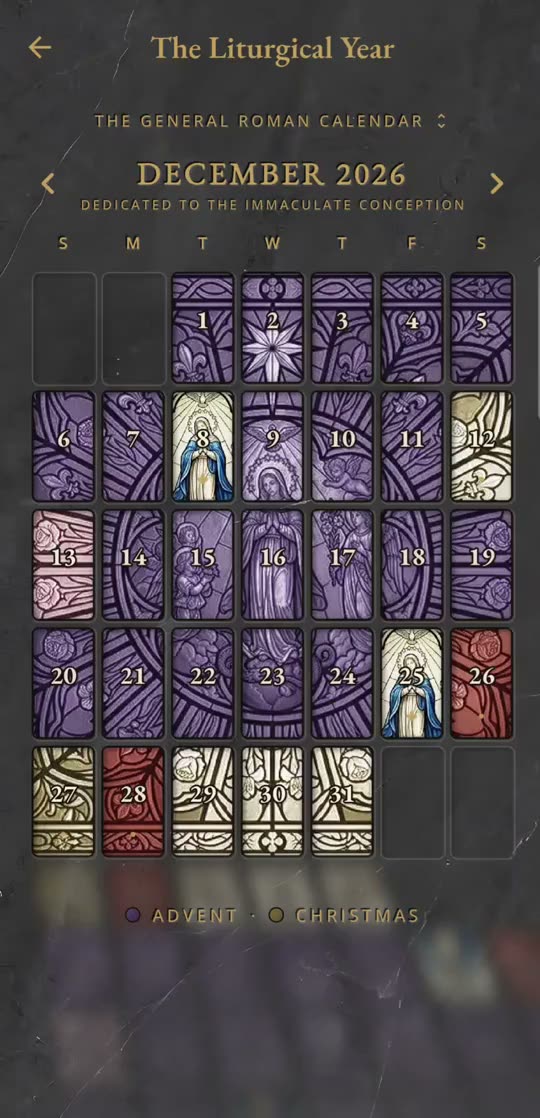
- A calendar in the Church's colours. The liturgical calendar is stained glass: violet through Advent, rose on Gaudete Sunday, white for the Immaculate Conception and for Christmas. It carries both the current calendar and the 1962 calendar. Free.
- The season explained by its best teacher. The Season of Advent page gives Guéranger on the history, the mystery, and the practice of Advent, and the Proper of the Day gives each day's feast or saint from sourced Catholic texts. Free.
- Retreats, free. Close your chosen apps for a set stretch with no toll and no way through: the hour before Mass, the evening of December 24.
- Friday Penance, free. The countdown at the wall lengthens on Fridays, in Advent as in the rest of the year.
- The Vow, in premium. Seal your disciplines so they can be deepened but never loosened until a day you name. The seal sheet suggests the coming solemnities from the calendar, so a Vow sealed on the First Sunday of Advent can hold until Christmas Day and release as the feast begins. How the Vow works.
- The Bookshelf at every wall. Each wall offers a door into a reading room of Catholic classics in place of the app. The whole Douay-Rheims Bible, the Imitation of Christ, the Confessions, and more are free; Guéranger's Liturgical Year in full is part of premium.
A simple rule for Advent 2026
- Before November 29, pick the two apps that take most of your time and put them behind the Praywall. Two are free.
- On November 30, take up the St. Andrew Christmas Novena and keep it to Christmas Eve.
- Choose one closed stretch a day, the first hour after waking or the last before bed, and set a Retreat over it.
- Give the reclaimed time away: to the Rosary, to the day's Mass readings, to confession before Christmas, to the people in the room. Fasting and almsdeeds went together in St. Leo's Advent sermons for a reason.
- From December 17, pray the O Antiphons each evening.
If you already pray with another Catholic app, keep it. A prayer app fills the time you set aside; an app blocker guards the rest of the day. They sit side by side. If you want the wider shelf of apps that lock your phone behind prayer, see Best Catholic App Blockers (2026).
Guéranger ends his instruction on the practice of Advent with a sentence that fits a phone as well as it fit a monastery: "The time of his coming is close at hand : let your heart, then, be on the watch ; and lest you should slumber when he arrives, watch and pray, yea, sing."
Get Catholic DeVice free for iPhone and Android.
Sources
- The Holy Bible, Douay-Rheims version with Bishop Challoner's notes: Matthew 3:1-3.
- Dom Prosper Guéranger, O.S.B., The Liturgical Year, vol. 1, Advent (tr. Dom Laurence Shepherd): The History of Advent, The Mystery of Advent, Practice During Advent.
- Francis Mershman, "Advent," The Catholic Encyclopedia, vol. 1 (1907).
- Catechism of the Catholic Church, 524.
- General Instruction of the Roman Missal, nos. 53, 305, 313, 346; Universal Norms on the Liturgical Year and the Calendar, no. 39; Code of Canon Law, canons 1250-1251.
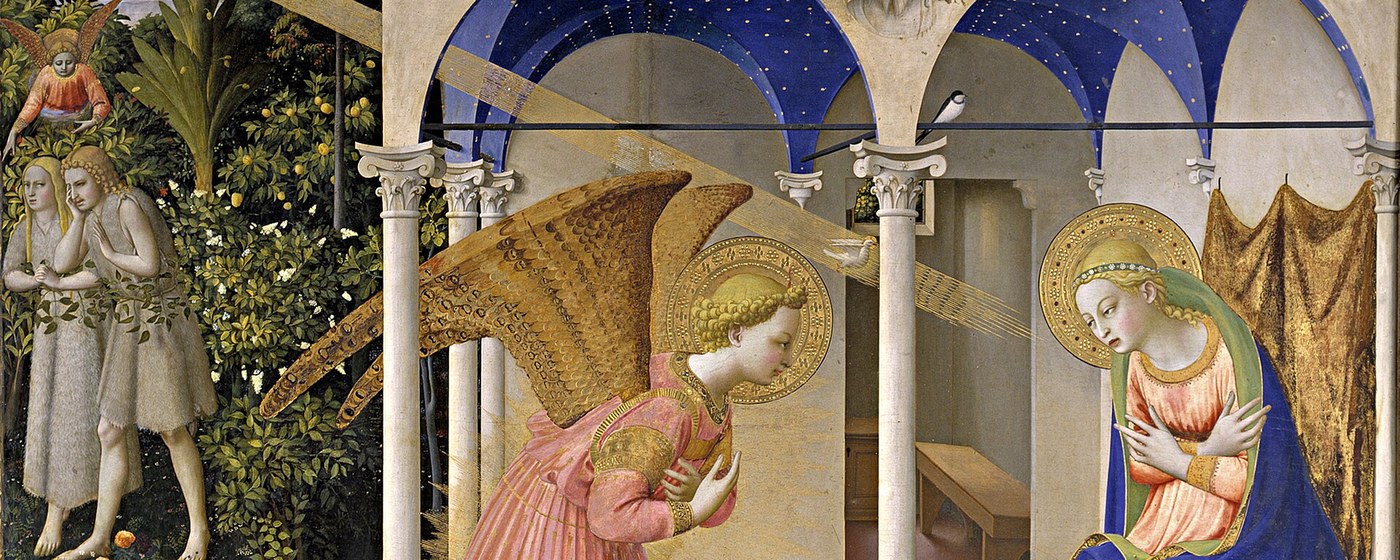
- Image: Fra Angelico, The Annunciation, c. 1425-1426, Museo del Prado, Madrid (public domain). Gabriel greets the Virgin while Adam and Eve leave Eden at the left edge: the Fall and its remedy in one panel. The same painting leads the Treasury in Catholic DeVice through Advent.
Questions people ask
What is a good Catholic Advent app?
It depends on the job. For guided audio and daily reflections, the large Catholic prayer apps publish Advent series every year. For the penance side of the season, Catholic DeVice is a free Catholic app for iPhone and Android that stands a full Catholic prayer, the Praywall, in front of the apps you choose every time you open them, all day. In Advent it carries the St. Andrew Christmas Novena from November 30 to Christmas Eve and the Great O Antiphons from December 17 to 23, both free, a liturgical calendar that turns violet for the season and rose on Gaudete Sunday, and a write-up of the season from Dom Guéranger's Liturgical Year. Nothing in it is AI-generated and it keeps no streaks.
Is Advent a penitential season?
In its origin and in its liturgy, yes. Dom Guéranger writes that the feast of Christmas "had every right to the honour of being prepared for by prayer and works of penance", and from the fifth century the West kept a fast from St. Martin's Day, November 11, to Christmas, known as St. Martin's Lent. The fast faded, and today's Church law names only Fridays and Lent as penitential days, so no Advent fast binds. The liturgy still keeps the character: violet vestments, no Gloria at Sunday Mass, moderation in flowers and the organ (General Instruction of the Roman Missal 53, 305, 313, 346). The Church today calls Advent a period of devout and expectant delight, and the penance a Catholic takes up in it is freely chosen.
When does Advent start in 2026?
Advent 2026 begins on Sunday, November 29, the Sunday nearest the feast of St. Andrew, and runs through Christmas Eve, Thursday, December 24. The Immaculate Conception falls on Tuesday, December 8, Gaudete Sunday on December 13, and the Great O Antiphons are sung from December 17 to 23.
What was St. Martin's Lent?
The old Advent fast. St. Gregory of Tours records that St. Perpetuus, bishop of Tours about the year 480, decreed a fast three times a week from the feast of St. Martin, November 11, until Christmas, and a synod at Mâcon in 581 ordered Mass on Mondays, Wednesdays, and Fridays of that stretch to follow the Lenten rite. It ran about forty days, which is why it was called a second Lent. Over the centuries it was shortened to four weeks and softened to abstinence, and then it fell out of use in the West. The Eastern Churches still keep a forty-day Nativity Fast.
Do Catholics have to fast during Advent?
No. Current Church law binds fasting on Ash Wednesday and Good Friday and abstinence on the Fridays it names, and it lists Fridays and Lent as the penitential days and times. Any Advent fast is voluntary. That is also its value: a chosen penance, such as a fast from the phone, offered to prepare for the birth of the Saviour.
Is there a free Catholic Advent app?
Yes. Catholic DeVice's core is free forever on iPhone and Android, not a trial: the Praywall on two apps, Retreats that close your apps for a set stretch, Friday Penance, the liturgical calendar with the Proper of the Day, the St. Andrew Christmas Novena, the Great O Antiphons, and all statistics. Premium adds unlimited apps, recurring schedules, the Vow, and the larger library, including Guéranger's Liturgical Year in full.
Ready to turn vices into virtues?
Catholic DeVice is free on iPhone and Android. Mark your vice apps, and the Praywall turns the moment of temptation into a moment of prayer.
Get the App Free